Using leaves, fruits, and roots readily available in nature, artisan Le Vo Son Quan has applied the Natural/Eco-Printing technique to transform Vietnamese silk into artworks that are not only visually captivating but also deeply connected to nature and cultural heritage. Each piece of Vietnamese Silk is more than a textile—it is a dialogue between plants, climate, human skill, and time.
Understanding Eco-Printing and its renaissance in Vietnam
Eco-Printing is one of the oldest natural dyeing and printing techniques known to humankind. Long before synthetic dyes existed, people across Asia, Europe, and the Middle East used leaves, flowers, bark, and fruit peels to imprint colors and organic patterns onto fabric. These patterns were never identical, because nature itself never repeats exactly the same form.
However, as industrialization accelerated, Eco-Printing and natural dyeing gradually faded from mainstream textile production. Chemical dyes, with their low cost, fast processing, and uniform results, came to dominate the market. While efficient, industrial dyeing also brought serious consequences: environmental pollution, health risks for workers, and the loss of traditional knowledge.
In recent years, amid growing global concern for sustainability, Eco-Printing has experienced a quiet renaissance. In Vietnam, this revival has been shaped by individuals who see natural dyeing not as nostalgia, but as a future-oriented craft. One of those individuals is Le Vo Son Quan.
With an academic background in chemistry and a long-standing passion for handicrafts, Mr. Quân approached Eco-Printing from both scientific and artistic perspectives. He understood that naturally dyed silk is gentler on the skin, safer for artisans, and significantly less harmful to the environment. More importantly, it carries a living quality—colors that breathe, evolve, and tell stories.
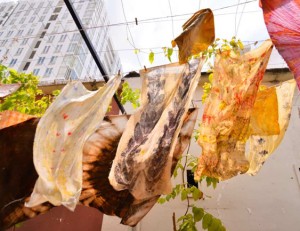
Determined to revive this technique, he spent years traveling across Vietnamese craft villages, observing traditional practices, experimenting independently, and researching plant-based pigments. Eventually, he chose Vietnamese silk as his primary medium, believing it to be the most refined canvas for natural colors.
For further reading: Vietnamese gifts: Handcrafted cultural treasures from Vietnam
The scientific art of natural dyeing silk
Vietnam is uniquely suited for Eco-Printing due to its rich biodiversity. From northern mountains to southern river deltas, the country offers an abundance of dye-yielding plants. Leveraging this advantage, Lê Võ Sơn Quân sources pigments from turmeric, grape skins, mangosteen peels, mulberry leaves, indigo, and củ nâu (madder root), among many others.
Depending on the desired effect, he may dye the silk at the thread stage or after the fabric has been woven. Each method produces different textures and color depth. The process itself is meticulous and time-intensive. Raw plant materials are carefully cleaned. Water pH is measured and adjusted. Mordants—used to fix colors—are selected with strict attention to safety and environmental impact.
What makes Eco-Printing truly fascinating is its unpredictability. A slight change in temperature, humidity, or mineral content in water can dramatically alter the final hue. The same leaf harvested from different regions, or even from the same tree in different seasons, can produce entirely different color palettes. Sometimes the result is a soft honey yellow, other times a deep forest green, or earthy brown reminiscent of fertile soil.
This variability is not considered a flaw. On the contrary, it is the essence of Eco-Printing. It ensures that no two pieces of silk are ever the same. At Uniquegifts, each naturally dyed silk scarf becomes a singular work of art—unrepeatable, organic, and alive with subtle gradients.
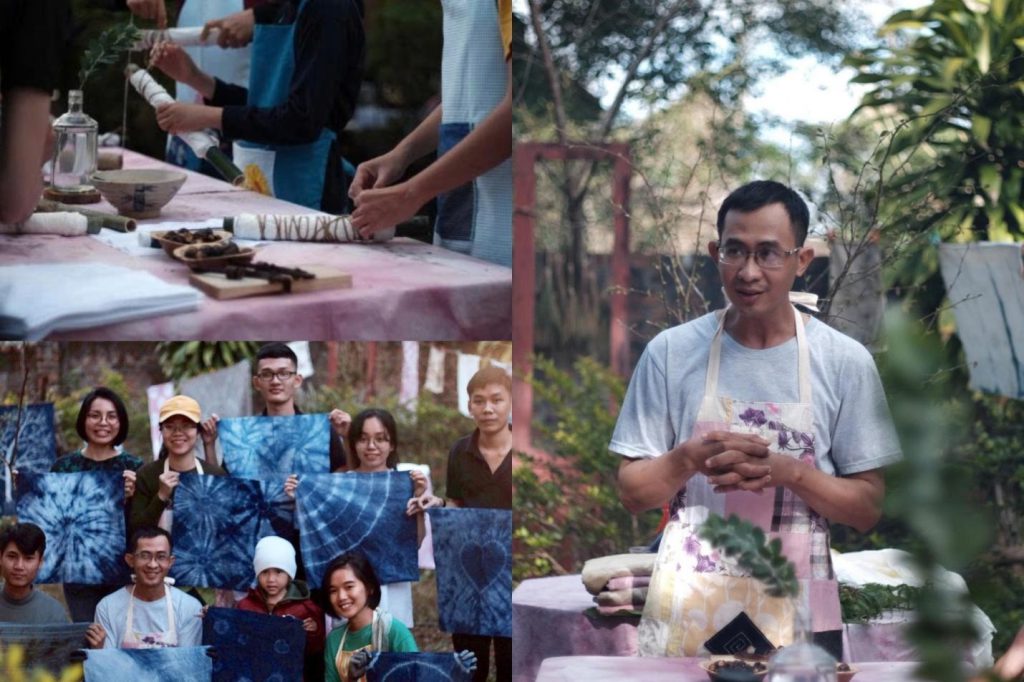
Beyond his own practice, Le Vo Son Quan is deeply committed to sharing knowledge. He regularly organizes workshops to introduce Eco-Printing to young people, designers, and craft enthusiasts. For him, natural dyeing is not merely a technique; it is a way to reconnect people with nature and to remind them of slower, more mindful modes of creation.
These workshops also play a crucial role in preserving intangible cultural heritage. By teaching others, Mr. Quan ensures that Eco-Printing does not remain an isolated practice but becomes a shared craft that can evolve across generations.
Building upon this rich material foundation, artists at Uniquegifts further develop creative designs, layering patterns, compositions, and artistic concepts onto naturally dyed silk. The result is a collection of scarves that balance elegance with authenticity—pieces that feel luxurious without being excessive, refined without losing their natural soul.
Choosing a naturally colored silk scarf at Uniquegifts means choosing more than fashion. It is a statement of values: respect for nature, appreciation of craftsmanship, and support for sustainable creativity. Whether given as a meaningful gift or worn as a personal expression of style, each scarf carries within it the story of Vietnamese land, plants, hands, and heritage.
For further reading: Chang Son fan village
For further reading: Uniquegifts: The journey of preserving Vietnamese identity through unique handmade gifts
Author: Anh Khuê